The seed a heartbroken teenager mailed to a friend he betrayed
Avi Rozen was fifteen when his father was killed defending Israel in the Yom Kippur War. His best friend, an Israeli Arab boy named Hamish, came to his door to grieve with him. Rozen sent him away with a string of obscenities, blaming him, an innocent boy, for his father's death simply because of who his people were. Hamish bowed his head and walked away, and Rozen never saw him again.
For years afterward, Rozen carried a hatred so total it eventually turned inward; he attempted suicide twice. What finally began to shift things happened on a survival course in the Arizona desert, under a night sky, lying next to a man he'd spent two weeks refusing to speak to: Yusuf al-Falah. Al-Falah said simply, it's the same night sky we see from Jerusalem, and asked Rozen to tell him about his father.
Rozen talked for hours, about walks, soccer games, Saturday breakfasts, and found, to his own surprise, that grief he'd sealed off for years came flooding back, along with the love underneath it. He calls this finding an out-of-the-box place: a relationship, a memory, an activity, or even a location that remains untouched by the blame and self-justification a person is carrying toward someone else. Everyone has them, al-Falah argues, even people who are deeply stuck in conflict elsewhere in their lives, because nobody colludes with every single person they know.
A few days later, Rozen came across a century plant in full flower, a plant that lives up to twenty-five years but flowers only once, in its final season, showering seeds that start the next generation. He saw in it the friendship with Hamish he had killed before it could rise. He wrote Hamish a letter of apology, enclosing one of the plant's seeds, and sent it into the desert mail run.
He never heard back. Hamish had moved, and was killed years later in a rocket attack before the letter could reach him, if it ever did. Rozen says the letter still mattered, because it was never really for Hamish alone. Writing it was how he finally received the friendship back into himself.
Make a short list of the relationships in your life right now where you feel no need to blame anyone or justify yourself; these are already your out-of-the-box places, even while you might be stuck toward someone else entirely. Notice what reliably takes you there, whether it's a particular person, a memory, a piece of music, or somewhere you used to go, and write it down so you're not relying on stumbling into it by accident. The next time you feel the walls of blame going up around someone, go to that place on purpose before you try to solve anything. From there, look at the person you're struggling with again and see whether something in how you see them has quietly loosened.
What You'll Achieve
You build a reliable, repeatable way to interrupt blame before it hardens, by deliberately returning to a relationship or memory that already holds clarity, rather than waiting for clarity to arrive on its own.
Locate your own out-of-the-box place
List the relationships where you currently feel no need to blame anyone.
These are your out-of-the-box places, and they exist even while you might be deeply stuck toward someone else entirely.
Collect what reliably takes you there.
A person, a memory, a piece of music, a place, or a passage from a book; note down what has worked before so you're not relying on chance.
Go there deliberately when you feel the box closing in.
Don't wait for it to happen by accident; actively seek out that relationship or memory the moment you notice yourself hardening toward someone.
From that vantage point, revisit the person you're struggling with.
Notice whether your view of them softens enough to see something new that the box had been hiding from you.
Reflection Questions
- Which relationships in your life right now are free of blame and justification, even if others are not?
- What memory, place, or piece of music reliably softens you when you're feeling hardened toward someone?
- Is there a letter, apology, or gesture you've been putting off because you're not sure it will be received the way you hope?
Personalization Tips
- Someone calls an old mentor before a hard meeting specifically because that relationship reliably clears their head.
- A person plays a particular piece of music that recalls a peaceful memory before confronting a difficult family member.
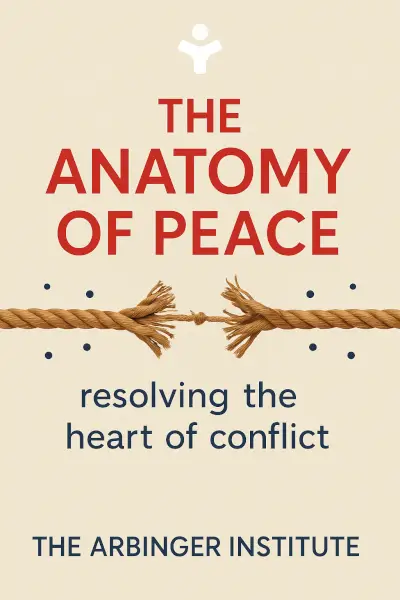
The Anatomy of Peace: Resolving the Heart of Conflict
Ready to Take Action?
Get the Mentorist app and turn insights like these into daily habits.