How a fight about lawn edging explains wars between nations
Avi Rozen was fifteen minutes from a tennis game and still had a lawn to mow. He raced through it, skipped the edging, and was halfway up the stairs when his wife Hannah called out to ask whether he was going to edge after all. What followed was an argument over a few feet of grass that, Rozen later realized, revealed something much larger.
He protested. She pushed back. He started seeing her as demanding and unreasonable. Seeing her that way, he acted more selfishly. Acting that way, she started seeing him as self-centered and immature. Seeing him that way, she pushed harder. Around and around it went, each of them provoking exactly the behavior they were complaining about in the other.
Rozen and Yusuf al-Falah call this collusion rather than conflict, because conflict suggests something that merely happens to people, while collusion is something people actively manufacture together, each supplying the other's justification. And they argue the pattern doesn't stay contained to two people. We recruit allies, friends, coworkers, entire departments, who agree with our accusing view of the other side, and the conflict spreads from a couple to a family to an organization to a nation.
Al-Falah traces this all the way back to Abraham's two sons, Isaac and Ishmael. Jews and Christians believe Isaac was the chosen son with rights to the land; many Muslims believe it was Ishmael. Centuries of descendants on each side have felt mistreated by the other, gathered their own allies, and provoked exactly the behavior they say they're fighting against. Substitute either name into Rozen's lawn-edging diagram, al-Falah says, and it still fits.
The uncomfortable implication is that being right about the underlying dispute, who deserved the land, who started the war, who should edge the lawn, doesn't stop collusion, because collusion isn't about who's correct. It's about what happens once both sides have started seeing each other as objects to manage rather than people to understand. Breaking it never starts with winning the argument. It starts with someone refusing to keep feeding their half of the loop.
Take one fight you keep having with the same person and actually diagram it: what they do, how it makes you see them, what you do in response, and how that in turn makes them see you. Somewhere in that loop you'll find you're both supplying each other's justification. Notice who you complain to about this person, because gathering allies who nod along with your accusing view is usually how a two-person disagreement quietly becomes a group war. Catch yourself the next time you lump someone into a flat label like typical anything, and force yourself to use their actual name instead. You can't make the other person stop their half of the pattern, but you were never actually required to keep feeding yours.
What You'll Achieve
You start seeing your recurring conflicts as a loop you help sustain rather than a fixed situation done to you, and you gain a way to interrupt your own contribution even when you can't control the other side.
Break your part of the pattern
Diagram one repeating fight.
Write down what the other person does, how it makes you see them, what you then do, and how that makes them see you; look for the loop.
Ask who you're recruiting.
Notice who you complain to about this person, since gathering allies who agree with your accusing view is often how a two-person conflict becomes a group war.
Refuse to demonize the whole category.
Catch yourself lumping someone into a lifeless label such as typical manager or just like all of them, and replace it with their actual name.
Break the loop from your end.
You cannot make the other person stop, but you can stop feeding your half of it starting with your very next response.
Reflection Questions
- Can you diagram one of your recurring conflicts the way Rozen diagrammed the lawn-edging fight?
- Who have you recruited to agree with your view of the person you're in conflict with, and what does that do to the conflict?
- Where in your life have you lumped a whole group of people into a single flat label instead of dealing with individuals?
Personalization Tips
- Two departments trade complaints about each other until neither will share information, and both sides feel completely justified.
- A sibling feud spreads until aunts, uncles, and cousins have all quietly picked a side without ever hearing the original disagreement.
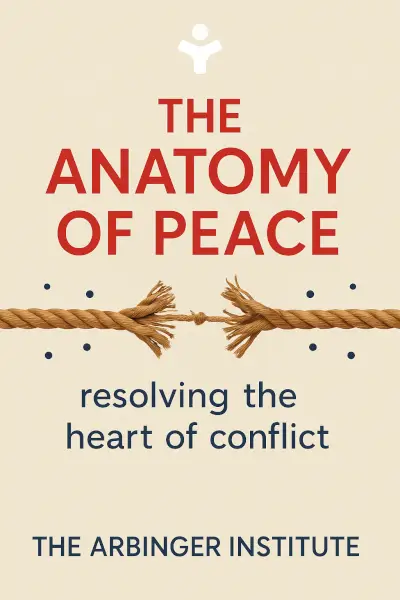
The Anatomy of Peace: Resolving the Heart of Conflict
Ready to Take Action?
Get the Mentorist app and turn insights like these into daily habits.