The four excuses your mind reaches for when you know you're wrong
When Yusuf al-Falah and Avi Rozen sit with parents at Camp Moriah, they draw four boxes on a whiteboard, and most people recognize themselves in at least one before the marker's even down.
The first is better-than: I see myself as smarter, more righteous, or more important, and I keep score. Rozen admits to falling into it over dinner once, at a nice restaurant on Valentine's Day, when he caught a foul smell and immediately decided the unkempt man at the next table was an inconsiderate scumbag ruining his evening. He complained until his wife had them moved. The smell turned out to be the restaurant's black beans, delivered with his own meal.
The second is I-deserve: I feel entitled, mistreated, owed something, and therefore justified in resenting whoever isn't providing it. Rozen's version showed up over a lawn, he mowed it in a rush before a tennis game, refused to edge it because he was running late, and spent the rest of the evening convinced his wife was being unreasonable for asking twice.
The third is worse-than: I see myself as inadequate or damaged, and I use that as an excuse to withdraw from other people rather than to fix anything. Rozen struggled with a stutter until he was nearly twenty, and instead of engaging with people, he pulled away from them, telling himself he couldn't be expected to do what came easily to everyone else.
The fourth is need-to-be-seen-as: I care more about appearing kind, tidy, or competent than about actually being any of those things. Al-Falah tells on himself here too, he once pushed a dropped piece of lettuce under the kitchen counter with his toe rather than bend down and pick it up, because leaving it visible might make his wife think less of him.
What ties the four together is that none of them require the other person to be right or wrong. They're simply the shapes self-justification takes once a person needs an excuse. Noticing which shape you reach for first tells you less about the person you're upset with than about yourself.
Think back to your last real argument and notice which excuse you reached for first: did you feel superior, entitled, worthless, or desperate to look good? It's fine to notice real differences between yourself and someone else; the trouble starts the moment you use those differences to rank whose feelings, time, or opinions matter more. Look for the small hidden version of your box too, the pushed-aside piece of evidence, the chore quietly skipped, the correction you never voiced because saying it might make you look petty. None of the four boxes require the other person to be right or wrong, so ask yourself plainly what you would do differently in this exact situation if you needed no excuse at all.
What You'll Achieve
You gain a concrete vocabulary for the excuse you personally reach for, which makes it faster to catch yourself mid-justification instead of only recognizing the pattern in hindsight.
Spot which box you reach for
List your default excuse.
Think of your last argument and notice whether you leaned on feeling superior, feeling entitled, feeling worthless, or feeling that you needed to look good.
Test whether you're merely noticing or scoring.
It's fine to see that someone is less experienced or more tired than you; the box appears when you use that fact to rank their worth against yours.
Look for the small hidden version.
A pushed-aside piece of lettuce, an unpicked-up coin, an unspoken correction can reveal a justification box as clearly as a shouting match does.
Ask what you would do differently with no excuse at all.
Picture the exact same situation minus any need to justify yourself, and notice what action becomes obvious.
Reflection Questions
- Which of the four boxes, better-than, I-deserve, worse-than, or need-to-be-seen-as, shows up most often for you?
- Can you recall a small, almost silly moment, like a piece of lettuce, where your box revealed itself more clearly than in any big argument?
- What would you do right now, in your current frustration, if you genuinely needed no excuse at all?
Personalization Tips
- A senior employee catches himself ranking colleagues by seniority instead of simply noticing their different skills.
- Someone tidies frantically before guests arrive not because the house needs it, but because being seen as untidy feels unbearable.
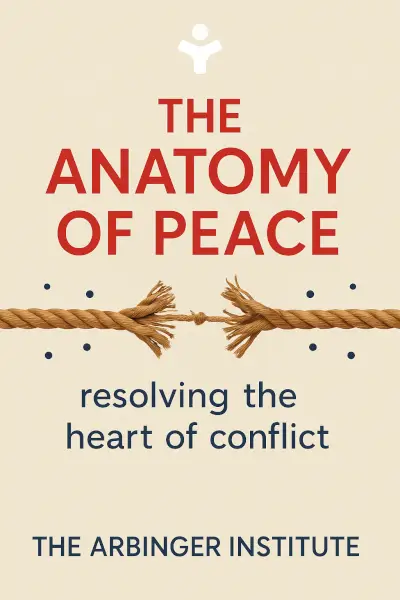
The Anatomy of Peace: Resolving the Heart of Conflict
Ready to Take Action?
Get the Mentorist app and turn insights like these into daily habits.