The forgotten king who won every war by refusing to hate his enemies
Yusuf al-Falah likes to begin with a story from nine hundred years ago. In 1099, Crusaders broke into Jerusalem and slaughtered most of its Muslim population within two days, burning bodies in heaps and selling survivors into slavery. They did the same to the Jews hiding in their synagogue and tortured the Christian priests who guarded the city's holy sites. Nearly a century later, the Muslim general Saladin recaptured the same city. His soldiers were ordered not to harm a single Christian or loot a single home. He ransomed the poor for almost nothing, let widows and children leave with gifts, and sent an armed escort to protect the wife of an enemy commander who had broken his word to Saladin and taken up arms against him anyway.
Historians sometimes explain Saladin's success as luck. Al-Falah argues it was something else entirely: Saladin's heart was at peace. Not soft, his armies were the most successful of the era, but at peace, in the sense that he still saw the people on the other side of his sword as people, not objects to be used or discarded.
This is the distinction the philosopher Martin Buber described as I-Thou and I-It: at every moment, we are relating to others either as people or as things, and almost any behavior at all, mowing a lawn, negotiating a contract, waging a war, taking a city, can be carried out in either way. The outward act can look identical. What changes everything is the state of the heart doing it.
Al-Falah's point is not that a heart at peace guarantees gentleness. Saladin still fought. It means that whatever you do, however hard or soft, is being done either toward a person or toward an object, and other people can feel the difference even when they cannot name it. A negotiator who sees the other side as people, rather than obstacles, understands their objections well enough to work around them. A parent who disciplines from a heart at peace lands differently than one who disciplines from contempt, even using the exact same words. The behavior is only ever the surface. Underneath it, in every interaction, a choice is already being made about what kind of thing the other person is.
Start today by naming your current way of being before you walk into anything difficult: ask yourself honestly whether you're about to see the other person as a person or as an obstacle in your way. Notice that whatever you're about to do, whether it's disciplining, negotiating, or simply having a hard conversation, can be carried out with contempt or with respect, and choose deliberately which one you want. Watch your own body for the early signs of war: the tightening jaw, the rehearsed put-down, the rising volume. When you catch one, pause and ask what a version of this same act would look like coming from a heart at peace, and then do that version instead, even if the words end up almost exactly the same.
What You'll Achieve
You start recognizing that your outward behavior and your inward regard for someone are two separate things, and you learn to check the second one before acting on the first, so that even firm or difficult actions stop provoking the resistance that contempt usually invites.
Notice the state of your heart before you act
Name your current way of being.
Before a hard conversation, ask yourself honestly whether you're about to see the other person as a person or as an obstacle in your way.
Look for the two ways to do the same thing.
Notice that whatever you're about to do, discipline, negotiate, or compete, can be carried out with contempt or with respect; choose deliberately.
Check for the physical signs of war in your body.
A tight jaw, a rising voice, a rehearsed put-down are all early signals worth pausing on before you speak.
Ask what a peaceful version of this act would look like.
Then do that version, even if the words you end up using are almost exactly the same.
Reflection Questions
- In your last difficult interaction, were you seeing the other person as an obstacle to your goal or as a person with their own reasons?
- Can you think of a time you did the technically right thing but still made a situation worse? What might your heart have been doing underneath it?
- Whose way of being toward you can you feel clearly, even when their words are polite?
Personalization Tips
- A manager preparing for a tense negotiation checks whether he's viewing the other side as obstacles or as people with legitimate concerns.
- A parent disciplining a child pauses to ask whether the correction is coming from contempt or from care, even though the words will sound similar either way.
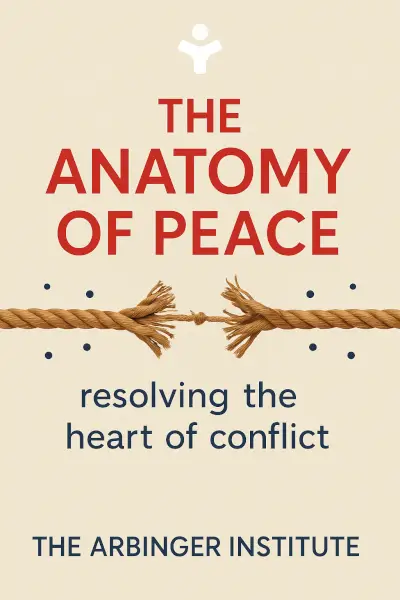
The Anatomy of Peace: Resolving the Heart of Conflict
Ready to Take Action?
Get the Mentorist app and turn insights like these into daily habits.