Harness family bonds with kin-selection math
Evolution doesn’t run on warm fuzzies or moral commandments. It runs on gene survival. Yet genes never fly solo—they exist in bodies surrounded by kin whose welfare indirectly preserves the same DNA. W. D. Hamilton’s kin-selection theory pinpoints a simple truth: you’re worth more to yourself than to a cousin, but a brother’s worth half you. If you risk your life to save a sibling, you save enough shared genes to make the sacrifice, but running into burning buildings for a random passerby doesn’t neatly add up.
How do you know who counts as kin? By relatedness fraction: parent-child is ½, sibling ½, grandchild ¼, aunt-niece ¼, first cousin ⅛. These fractions reflect how many copies of a given gene any relative is likely to share with you. Think of fire drills in school—the more students shout “fire,” the more you trust the alarm. Similarly, shared DNA is your biological alarm system for altruism.
In nature, animals rarely calculate these fractions consciously, but they behave as if they did. A meerkat alert call carries a tiny personal risk, yet meerkats call more often when close relatives are in the group. Their unconscious “if she’s my sister, I’ll stay at risk for her” decision echoes the precise logic of kin selection.
This is not cold math—knowing who your true “tribe” is can guide your real-world generosity. You might back a sibling’s risky startup more than a stranger’s, while still stretching help to friends in need, because humans build other cooperative systems on top of this genetic core.
Capture the logic of kin selection tonight by sketching your own family tree. Compute relatedness to a sibling, cousin, and grandparent. Then reach out—send a small favor that lines up with how closely you’re related. You’ll see kinship math in action when you notice how much each gesture truly counts.
What You'll Achieve
You’ll understand which relationships are biologically primed for cooperation, leading to more satisfying support networks and focused generosity.
Calculate your closest genetic ties
Draw your family tree
Sketch three generations—grandparents, parents, you, siblings, cousins. This visual map helps you spot shared ancestors that matter for cooperation.
Compute relatedness fractions
Use the rule—each step up or down the tree halves the fraction—to calculate your relatedness to siblings (½), cousins (⅛), and grandparents (½).
Apply selective support
Identify one collaboration or favor to offer each relative group. Match your help roughly to how closely you’re related to them.
Reflection Questions
- Who in your life shares half your genes, and how could you strengthen that bond?
- In what situations do you find yourself helping strangers more than close kin?
- How might mapping relatedness fractions shift how you allocate your time and resources?
Personalization Tips
- Offer extra mentoring to a sibling struggling at school (relatedness ½).
- Help a first cousin prepare a job application (relatedness ⅛).
- Coordinate a grand-parent story time for family bonding (relatedness ½).
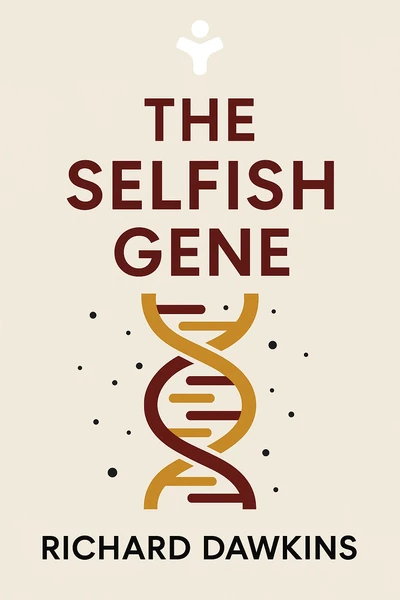
The Selfish Gene
Ready to Take Action?
Get the Mentorist app and turn insights like these into daily habits.