Use your ear to strengthen rhythm, transitions, and sentence variety
In workshops, I ask people to read their work aloud. There’s always a moment when someone stops, laughs, and says, “Okay, I hear it.” A paragraph they thought was smooth turns out to be a marathon. Another line that looked fine on paper sounds flat. The ear is a ruthless but fair editor. It tells you where rhythm drags, where transitions confuse, and where sentences all march at the same length until the reader dozes.
Once, I brought a page to a newsroom mentor, proud of a complex, winding sentence. He listened, then tapped the desk. “Good,” he said, “now give me one that snaps.” I wrote a short follow‑up line. Together, they worked. The long line carried nuance, the short line carried energy. That day I started marking my drafts with S for short and L for long, just to see the pattern.
Transitions get kinder when you announce them early. Readers shouldn’t discover at the period that the sentence was a turn. Start with But, Yet, However, or Meanwhile when you pivot. A science teacher I shadowed did this in lectures so smoothly that even tricky shifts felt obvious. I tried it in my own writing and emails. People stopped asking for clarification.
I might be wrong, but most editing problems hide in sound. Prosody—the rhythm, stress, and intonation of speech—matters on the page because we subvocalize while reading. Cognitive studies show that clear connectors reduce processing effort and varied sentence lengths improve engagement. Your ear is tuned to these cues naturally. Use it.
So read to someone. Vary your sentence lengths. Lead with connectors at pivots. Cut the preambles that take up space without adding meaning. Your prose will breathe, and readers will too.
Grab a colleague and read your draft aloud, marking every stumble, breathless run, or dull patch. Then vary your sentence lengths on purpose, follow long with short, and add clear connectors at pivots so nobody has to re‑read. Cut preambles like “It’s important to note that” and start with your point. This quick ear‑pass turns stiff prose into something people actually want to finish—try it on your next page.
What You'll Achieve
Internally, you’ll build confidence in your ability to hear problems. Externally, your writing will gain rhythm, clearer transitions, and higher reader engagement.
Edit by ear every time
Read to someone out loud
Ask a friend to listen while you read. Mark any stumble, breathless run, or flat spot. Ears catch what eyes miss.
Vary sentence length on purpose
Follow a long sentence with a short punch. Use this contrast to wake the reader’s attention.
Lead pivots with clear connectors
Start sentences with But, Yet, However, or Meanwhile to flag shifts early. This helps working memory.
Trim preambles
Cut “It’s important to note that…” and similar throat‑clearers. Start with the point.
Reflection Questions
- Where did I stumble or run out of breath while reading?
- Do any three sentences in a row have the same length and feel?
- Which pivot needs a connector at the start?
- What preamble can I cut to reveal the point?
Personalization Tips
- Work: Read a big email to a teammate before sending; cut every spot where you gasp.
- Creative: In a poem draft, alternate one long sentence with two short lines to test rhythm.
- Education: Read a lesson aloud and insert “However” where you shift concepts to help students follow.
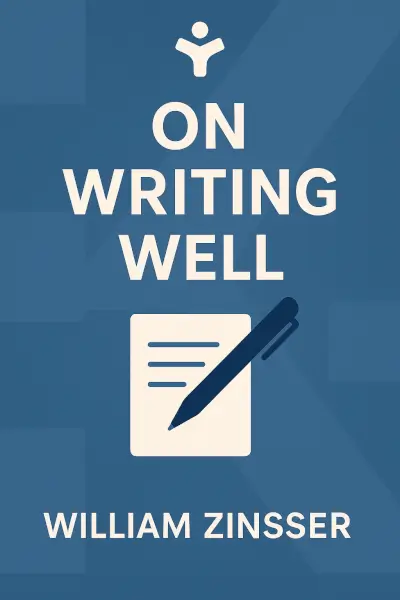
On Writing Well: The Classic Guide to Writing Nonfiction
Ready to Take Action?
Get the Mentorist app and turn insights like these into daily habits.