What happened to his podcast during the worst week of his life
What do you do when someone you love is dying, and the rest of your life doesn't pause to let you grieve? David Kadavy found out on July 4th, 2019. He'd just finished a good morning of writing in Medellín, cooked lunch, and picked up his phone off the kitchen counter. That was, he says, his last moment of blissful ignorance. His mother had suffered a sudden brain hemorrhage back in Phoenix and was in a coma. He was on a plane within hours.
Most people would assume, reasonably, that a crisis like this means everything else stops. Kadavy decided the opposite would be safer for his sanity, that keeping at least one part of his working life intact, his weekly podcast, was worth protecting, not despite the tragedy but partly because of it. The real question was whether a system built for ordinary days could survive an extraordinary one.
It could, but only because it hadn't been built to depend on ordinary days going well. Kadavy had already organized his task list not by project, but by the mental state each task required, so that at his mother's bedside, drained and barely able to think, he could still find tasks tagged for the kind of loose, low-effort exploring he was capable of that day, and skip anything tagged for sharper planning or generating. He wrote podcast intro scripts in stream-of-consciousness bursts, trusting the mess to become usable later.
He'd also built what he calls a Creative Cascade, a chain of inboxes running from a small pocket notebook up through project files, so that any thought, however small or however large, had somewhere to land the instant it occurred to him, without demanding he act on it right then. On the flight to Phoenix, not knowing what he'd find at the other end, he simply opened his laptop and wrote down everything happening to him, beat by beat, into one of those inboxes, not for any book, just so it wouldn't be lost.
His mother died several weeks later. Kadavy is careful not to claim any of this happened for a reason. What he does claim is that a system built to bend, rather than one built to depend on everything going right, kept working when almost nothing else in his life was under his control, and that a rigid schedule that shatters the moment reality intrudes is a worse risk to take with something you actually care about finishing.
Start tagging your tasks now, before any crisis hits, by the kind of energy each one needs, sharp planning, loose exploring, or almost nothing at all, so that on a genuinely bad day you can still scan the list and find something you're actually capable of doing. Keep a small notebook or a note on your phone that you can reach without thinking, and build a habit of moving whatever lands in it into the right place during a regular weekly check-in, so no thought gets lost while you're overwhelmed. On your worst days, don't abandon your most important habit entirely; shrink it down to the smallest possible version instead. And once the crisis eases, look back at what held and what broke, and use that to make the system a little sturdier for next time.
What You'll Achieve
The listener builds slack and flexibility into their routines and task systems before a crisis forces the issue, tagging work by the energy it requires so they can keep some momentum even on their worst days. They stop expecting their systems to work only when life is cooperating.
Design systems that bend instead of shatter
Sort your tasks by the energy they need, not just their deadline.
Tag each task by whether it needs sharp planning, loose exploring, or almost no effort at all, so that on a bad day you can still find something you're capable of doing.
Build a chain of inboxes before you need one.
Keep a small notebook or note app you can reach instantly, and a habit of moving what's in it into the right project file during a regular weekly check, so nothing important gets lost while you're overwhelmed.
Lower the bar on your worst days instead of skipping entirely.
When you have almost nothing left, do the smallest possible version of your most important habit rather than abandoning it completely.
Expect the plan to break, and build slack into it anyway.
Don't design a routine so tightly integrated that one bad week destroys the whole thing.
Revisit and rebuild after the storm passes.
Once the crisis eases, review what held and what broke, and use that to strengthen the system for next time.
Reflection Questions
- If a serious crisis hit you tomorrow, which of your current routines would survive, and which would collapse immediately?
- Do you have anywhere to instantly capture a thought when you're too overwhelmed to act on it?
- What's the smallest version of your most important habit that you could still do on your worst possible day?
Personalization Tips
- Someone caring for a sick relative might keep writing just fifty words a day on a personal project instead of stopping entirely, trusting that a little is better than none.
- A small business owner during a family emergency might rely on a pre-written social media schedule instead of trying to create fresh content from scratch that week.
- A student overwhelmed by a personal crisis might switch from writing new material to only reviewing flashcards, a lower-effort task, rather than giving up on studying altogether.
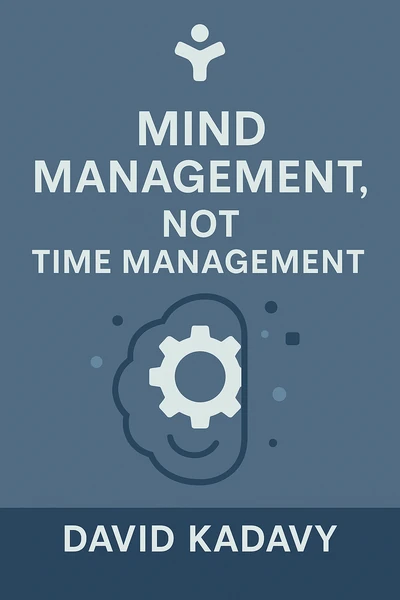
Mind Management, Not Time Management: Productivity When Creativity Matters (Getting Art Done Book 2)
Ready to Take Action?
Get the Mentorist app and turn insights like these into daily habits.