Saving five minutes on the subway might be costing you your best ideas
There's an app called Exit Strategy that tells New York subway riders which car to board so that, when the train stops, they'll be closer to the exit. It advertises that it can shave minutes off a commute. David Kadavy points to it as a symptom of something he calls time worship: the belief that any moment not crammed with output is a moment lost.
He noticed the same instinct in a college neighbor who ran everywhere, all the time, because, as the neighbor explained, it saves time. Kadavy admits he did his own version, teaching himself to press his apartment's elevator button by looking in a mirror rather than turning around, a trick he calculated saved him about two seconds a week.
None of this is really about efficiency. It's about a culture that treats time the way it treats money, as something you must never leave idle, even though, as Frederick Taylor discovered while timing steelworkers over a century ago, pushing any resource past a certain point stops helping and starts hurting. Taylor's own experiments showed that workers pushed to move iron faster and faster eventually collapsed, producing less for the day than if they'd been allowed proper rest. Economists call the point where extra effort produces less extra output the point of diminishing returns, and the point where it actually reduces your total output the point of negative returns.
Time management, Kadavy argues, rests on two mistaken assumptions: that every hour is the same as every other hour, and that being productive simply means producing more, faster. Neither holds up for creative work, where the value of an hour depends on your energy and the value of what you make depends on the quality of the idea inside it, not the speed of the typing.
He also points to examples suggesting that time left genuinely unused often pays off later: Bill Gates took secluded think weeks that led to Microsoft's first web browser, and Stephen King tells novelists to leave a finished draft in a drawer, untouched, for six weeks. Unused time, it turns out, isn't wasted. It's where the next idea quietly finishes cooking.
Start by catching yourself the next time you feel proud of shaving a few seconds or minutes off something trivial, and ask whether that saved time is actually buying you anything. Watch your own energy across a work session, and the moment each additional hour produces noticeably less than the one before it, stop instead of pushing through out of guilt. Deliberately leave a block of your calendar empty, and resist filling it just because it's there. And when you finish a piece of work you care about, put it away, untouched, for a few days before you judge it, trusting that the unused time is doing something for you even while you're not looking at it.
What You'll Achieve
The listener recognizes when they're chasing efficiency for its own sake and starts protecting unscheduled time instead of automatically filling it. They begin to notice the point where extra hours of effort stop paying off and adjust rather than pushing through out of habit or guilt.
Stop treating every empty minute as wasted
Notice when you're optimizing something that doesn't need optimizing.
If shaving a few seconds off a routine task isn't buying you anything meaningful, let it go, and put that attention toward energy instead.
Watch for the point of diminishing returns in your own work.
If an extra hour is producing noticeably less than the hour before it, that's a signal to stop, not push through.
Deliberately leave some time unclaimed.
Block out space on your calendar with nothing planned, and resist the urge to fill it, treating it the way you'd treat money left in savings to grow.
Let a finished piece of work rest before judging it.
Put a draft away for days or weeks rather than editing it immediately, the same way Stephen King recommends leaving a manuscript untouched before rereading it.
Reflection Questions
- What's a small time-saving habit you keep at that isn't actually buying you anything?
- Where in your week have you noticed effort producing less and less, and did you push through anyway?
- How would your calendar look if you treated unused time as savings instead of waste?
Personalization Tips
- Someone who checks email during dinner to stay on top of things might notice they're worse at both eating and thinking clearly afterward.
- A freelancer tempted to book every open slot on their calendar might instead leave a half-day genuinely free each week and see what surfaces in it.
- A writer who edits a chapter the moment it's finished might get better results setting it aside for a week first.
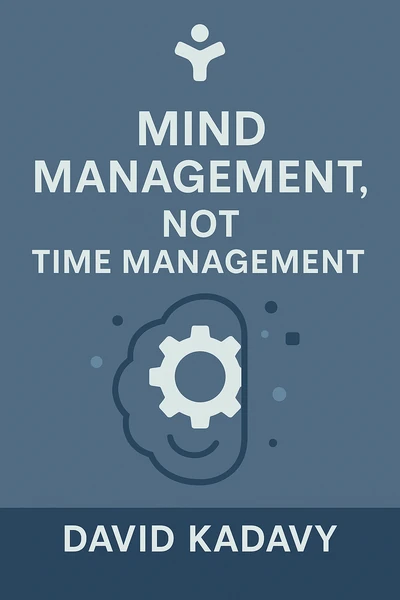
Mind Management, Not Time Management: Productivity When Creativity Matters (Getting Art Done Book 2)
Ready to Take Action?
Get the Mentorist app and turn insights like these into daily habits.