Most effort is noise, a few choices drive outsized results
Across fields, results rarely match effort one-to-one. Economists noticed that a small fraction of inputs generate a large share of outputs. In quality management, fixing a handful of defect causes transforms entire product lines. Investors concentrate in a few businesses. Software teams see a minority of features generate most usage. This pattern, sometimes called a power law, challenges the comforting belief that all hard work pays equally.
A practical way to see this is a simple time-impact audit. Take your last ten hours and rate the actual value created by each hour. You’ll likely notice two or three hours that moved the needle and several that felt busy but were low yield. Maybe a focused design review unlocked a team, or a hard customer call killed a bad idea early. The insight is not that the other hours were pointless, but that a small slice delivers disproportionate progress when you set the right conditions.
One product manager did this exercise and found that 90 minutes of user interviews clarified a roadmap more than three recurring meetings combined. She doubled the interviews, halved the meetings, and saw decisions speed up with fewer reversals. Her coffee went cold less often because she was doing work that absorbed her attention.
Scientifically, this aligns with Pareto’s observation and later work on heavy‑tailed distributions. In such systems, variance comes from rare, high‑impact events. For individuals, that means identifying the “vital few” behaviors and designing your week around them. It’s a mindset shift from equalizing your schedule to amplifying what compounds. That often requires uncomfortable cuts, but the math is on your side.
Audit your last ten hours and score impact, not effort. Circle the top one or two that drove the most value, then deliberately block two similar sessions next week at the same time and conditions. Pick a single low‑yield activity to shrink or stop for one week and watch what happens to outcomes, not just how busy you feel. Treat this like an experiment, then repeat the loop next Friday with fresh data. Give yourself permission to bet on what actually works.
What You'll Achieve
Shift from equal-effort scheduling to high-leverage time design; feel clearer and more confident while producing measurable gains in output and decision quality.
Map your 10X activities this week
List your last 10 hours of work
Write where the time actually went, not where you wish it went. Be concrete: meetings, emails, building, selling, learning.
Score impact, not effort
For each block, rate the result from 0–10 based on value created, not time spent. Examples: moved a deal, shipped code, clarified a decision.
Circle the top 10%
Identify the single hour or two that produced the largest return. Ask, “What made these hours different?” People, timing, problem type?
Schedule double of the best
Protect two more blocks next week for that exact kind of activity. Same place, same time, same conditions.
Cut a 70% activity
Choose one low‑impact habit (e.g., long status calls) and halve it or eliminate it for a week. Note the outcome.
Reflection Questions
- Which recent hour produced a 10x ripple, and why?
- What conditions make my ‘vital few’ activities possible?
- What am I willing to cut entirely for seven days to test this?
- Who benefits if I keep pretending all hours are equal?
Personalization Tips
- • Sales: If two calls per week with a specific vertical convert 4x, lock those slots and drop low‑yield demos.
- • Studying: If past papers drive your grades more than rereading, double past‑paper sessions and skip one review group.
- • Creative: If morning writing produces your best pages, protect two extra mornings and cut late‑night tinkering.
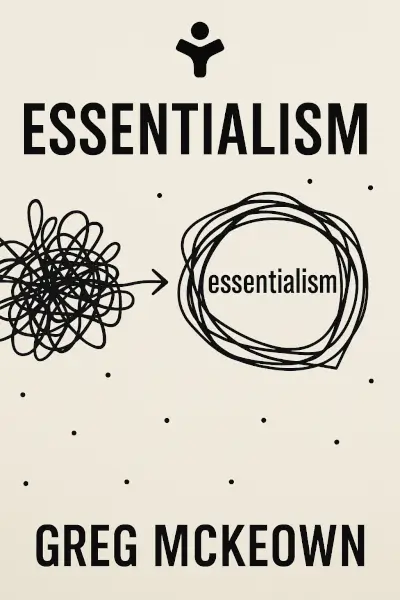
Essentialism: The Disciplined Pursuit of Less
Ready to Take Action?
Get the Mentorist app and turn insights like these into daily habits.