What happens the instant you multiply your dream income by five
Diego sat on his lunch break and let himself answer a question he'd been avoiding for months: what was the number he actually wanted to be earning in a year. An answer arrived almost instantly, unbidden, with a small lift in his chest. It felt obvious, almost playful, the way a kid answers what they want to be when they grow up.
Then he multiplied it by five.
Within seconds, a different kind of noise started. No one in his family had ever made that. He didn't know how he'd pull it off. Wanting that much probably made him greedy. By the time he was back at his desk, the lightness from a minute earlier had curdled into something closer to shame.
Joseph Nguyen uses this exact exercise to make a distinction he considers central to why we suffer: the difference between a thought and thinking. A thought, in his terms, is the raw idea that pops into your mind effortlessly, the way Diego's number arrived before he'd done anything at all. He argues that thoughts are not something we manufacture; they simply occur to us, seemingly from beyond our own personal history, which is why children can dream up plans no adult would consider realistic.
Thinking is what happens next, when we take that raw thought and start working it over: judging it, defending it, running it through our accumulated fears and past failures. This is effortful, and Nguyen argues it is where nearly all of our psychological distress is manufactured, not in the original thought itself. Diego's number didn't hurt him. What hurt was the ten minutes he spent afterward proving to himself why he didn't deserve it.
The practical use of this distinction, in Nguyen's account, is a kind of internal weather report. If an idea feels light and energizing, treat it as a thought worth keeping. If the same idea starts to feel heavy, restrictive, or full of dread, you're no longer looking at the idea, you're looking at your thinking about it, and that layer can be set down without losing the original thought underneath it.
Try asking yourself a real question about something you want, and notice the very first answer that shows up, because that quick, almost effortless response is the thought itself, arriving before any judgment has touched it. Pay attention to how it feels in your body in that first second, since a light or exciting feeling usually means you're still with the raw idea. Then watch for the moment your mind starts adding reasons the idea is unrealistic or shameful, because that shift into heaviness is thinking taking over, not new evidence about what's possible. When you catch that shift, try naming it out loud, so you can quietly set the commentary aside and keep the thought that started it all.
What You'll Achieve
You learn to catch the moment a fresh idea turns into self-doubt, so you can keep the idea and drop the doubt instead of losing both. Concretely, you'll notice yourself abandoning fewer good ideas simply because the follow-up thinking made them feel impossible.
Steps to tell a thought from thinking
Ask yourself an open question and notice the first answer
Pick something you want, like a dream income or a project, and ask yourself directly. Pay attention to the very first answer that appears, before you do anything else with it.
Clock how it felt in that first second
Right after the answer surfaces, check in with your body. If it felt light, expansive, or exciting, that was the raw thought, arriving with no argument attached to it.
Watch for the pile-on
Notice when your mind starts adding reasons why the answer is unrealistic, greedy, or impossible. That commentary is thinking, not the original thought, and it's where the heaviness starts.
Separate the two out loud if it helps
Say, that was the thought, and now this is thinking, so you can consciously set the second one aside instead of treating it as new information about reality.
Reflection Questions
- What is a goal you had that felt exciting for a moment before it started to feel heavy?
- Can you recall the exact sentence your mind used to talk you out of something you wanted?
- What would you attempt this week if you kept only the first thought and set the following thinking aside?
Personalization Tips
- Someone imagining quitting a stable job feels a spark of excitement the moment the idea appears, and only feels dread once they start listing every reason it's a bad idea.
- A student who dreams of studying abroad notices the same pattern: the wish itself feels light, but the mental list of obstacles that follows feels crushing.
- A parent considering asking for help around the house has an easy, obvious thought about what they need, then spends an hour thinking about whether it's fair to ask.
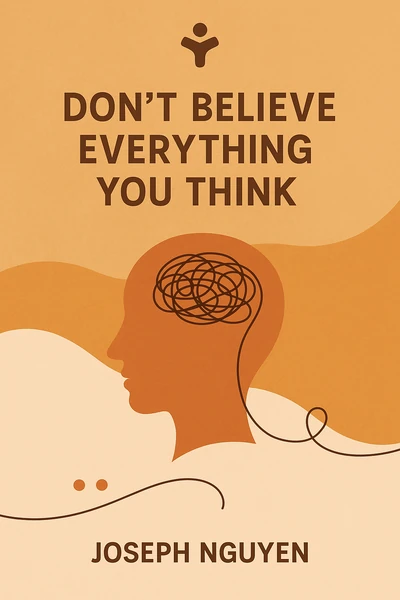
Don't Believe Everything You Think: Why Your Thinking Is The Beginning & End Of Suffering (Beyond Suffering Book 1)
Ready to Take Action?
Get the Mentorist app and turn insights like these into daily habits.