Why a Roman emperor kept retreating to a fortress no one could see
By AD 170, Marcus Aurelius had been emperor for less than a decade, and the empire was unraveling around him. The Tiber had flooded Rome. A plague carried home by returning legions was killing thousands. Tribes from beyond the Danube kept breaking into Roman territory, and Marcus, who had barely left Italy before, was now commanding troops on the northern frontier himself, in the cold, unfamiliar country of Pannonia.
It was here, far from any library, court, or comfortable retreat, that he wrote some of the most quoted lines in his private notebook. Men seek retreats for themselves, he told himself, in the country, by the sea, in the hills. But all this is unphilosophic, when it is open to you, at any time you want, to retreat into yourself. No retreat, he went on, offers more quiet than that into your own mind, especially if you keep a few fundamental thoughts ready there, ones that can wash away distress in a single visit and send you back calm to whatever you must rejoin.
Marcus calls this retreat a fortress, an inner citadel that no siege can reach, because unlike a house in the country or a villa by the sea, it travels with you. It cannot be requisitioned by an emperor's duties, flooded by a river, or infected by a plague. The only thing that can close it off is neglect, forgetting to visit it, or filling it with clutter instead of the short list of convictions that actually hold weight.
What makes this different from an afternoon off, or a holiday, is that Marcus Aurelius is not describing escape. He is describing a return to a fixed set of principles simple enough to recall under pressure, and he treats the failure to use them as a kind of self-neglect, no different from ignoring your own health. He wrote this while commanding armies, not while free of them. That is the point: the retreat has to work exactly when there is no way to leave the room.
Start by writing down, in your own words, two or three convictions you actually hold about what matters, simple enough to say to yourself in one breath, the way Marcus Aurelius reduced his to a handful of doctrines he could visit in a single sitting. Keep them somewhere you will see them, not just in a note you forget. When pressure builds, a deadline, a conflict, bad news, pause for the length of one breath and recite them before you speak or act. Practice this on small, low-stakes irritations first, so the habit is already running when a real crisis arrives. And when you notice yourself reaching for an external escape instead, ask what you are actually avoiding by not simply turning inward.
What You'll Achieve
You develop a portable set of core convictions you can return to under pressure, so that stressful moments stop hijacking your attention for hours and instead get met, within seconds, by a steady, rehearsed response.
Build and rehearse your inner retreat daily
Write your short list.
Put into your own words two or three convictions you actually hold about what matters, simple enough to say to yourself in one breath, the way Marcus Aurelius reduced his to a handful of doctrines he could visit in a single sitting.
Keep it visible.
Store the list somewhere you will actually see it again, not buried in a note you forget exists, so it is ready before you need it rather than after.
Rehearse on small stuff first.
Practice the retreat on minor irritations, a delayed train, a curt email, so the habit is already running when a real crisis arrives.
Notice when you reach outward instead of inward.
When you catch yourself reaching for a distraction, a trip, a scroll through your phone, ask what you are avoiding by not simply turning inward instead.
Reflection Questions
- What two or three convictions would actually hold weight if you recited them in the middle of a crisis?
- Where do you currently go to escape pressure, and does it actually calm you or just distract you?
- When was the last time you had a fixed principle ready before a difficult moment arrived, rather than scrambling for one in the middle of it?
- What would change if you treated neglecting this retreat as a form of self-neglect, the way Marcus Aurelius did?
Personalization Tips
- A nurse finishing a brutal double shift silently repeats her two working convictions before walking back onto the floor.
- A small business owner facing a canceled contract takes thirty seconds at her desk instead of reaching for her phone to distract herself.
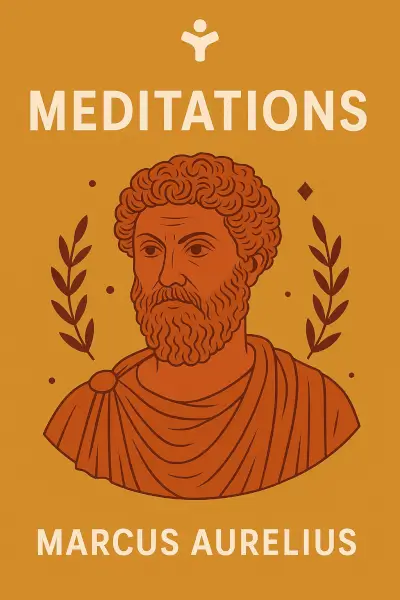
Meditations
Ready to Take Action?
Get the Mentorist app and turn insights like these into daily habits.