Redefine Problems Before Starting Solutions—Powerful Framing Changes Everything
Ask any builder, founder, or scientist, and they'll admit: most labor is wasted on solving the wrong problem or chasing a false goal. Einstein famously claimed he'd spend 19 out of 20 days defining the problem and only one on the solution. History’s best results—Palm Pilot’s breakaway success, Edison's system for electric lighting, even blockbuster films—come from leaders who reframed the challenge to reveal its core constraint or need.
The trick is, finding a good problem description is hard. Palm’s Jeff Hawkins listed 'fits in a shirt pocket' and 'syncs with a PC' as absolute musts, letting impossible-sounding requirements drive focus. His model? A carved block of wood carried in his pocket to test if it fit the real scenario.
Behavioral science confirms: the act of posing more specific, relatable, or visual questions activates different cognitive pathways and makes accidental discoveries more likely. When you prototype the problem—walk in its shoes, or physically act it out—you spot deal-breakers and creative shortcuts you’d never see on paper.
The result is solutions that are simple, memorable, and practical—a field-tested map for making progress, not just mental gymnastics.
Before launching into solutions, slow down and challenge yourself to reframe your challenge three different ways, adjusting the language to sharpen what the true need or constraint is. Gather vivid analogies or real-world standards to compare (the pocket, the pencil, the ten-minute rule). Where possible, make the problem tangible—sketch it, build a quick model, or act it out—so unseen issues rise to the surface before you invest energy in the wrong direction. This reframing habit will save you time, frustration, and bring transformative clarity to any project—so try it on your very next problem.
What You'll Achieve
Sharpen decision-making, reduce wasted effort, and discover breakthrough solutions by reframing challenges and testing definitions before acting.
Ask Better Questions to Spark Transformative Results
Spend Extra Time Defining the Real Challenge.
Before jumping to solutions, write out at least three different ways to define your problem, using specific language that pinpoints the underlying need or barrier.
Research Reference Points or Analogies.
Find strong images, standards, or comparisons (like 'the pencil,' 'fits in a shirt pocket,' 'as easy as a calculator') that clarify what makes or breaks your desired outcome.
Prototype the Problem Physically or Visually.
Map or even build a simple model to experience the challenge—carry around a cardboard mockup or act through a scenario to identify unseen requirements.
Reflection Questions
- Am I solving the real problem, or just the one that's familiar?
- What metaphors or standards define my actual need?
- How could a quick prototype reveal blind spots before I dig in?
- When have my assumptions led to wasted solutions?
Personalization Tips
- A student discovers their real difficulty in math isn’t algebra, but unclear instructions; they rephrase their assignments for clarity before starting.
- A home cook prototypes a dinner party by setting the table days in advance, realizing the challenge is space, not recipes.
- A group mapping a fundraising campaign realizes the true constraint is communication, not just money.
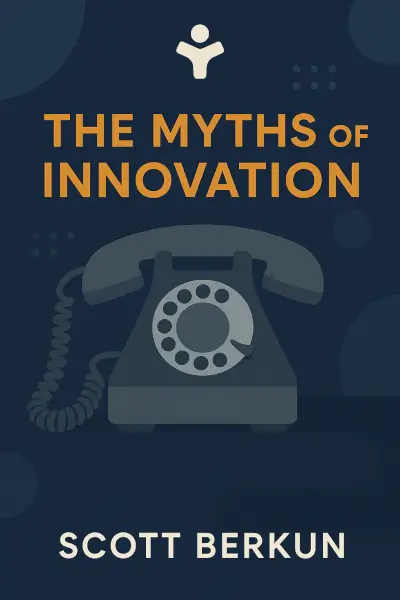
The Myths of Innovation
Ready to Take Action?
Get the Mentorist app and turn insights like these into daily habits.