Why Relentlessly Chasing Growth Can Sabotage Your Success
Most people grow up believing that business is like a hungry machine—it always needs to become bigger to survive. But what if adding more clients, more revenue, or more hours just piles on stress, reduces the joy in your work, or even brings your whole enterprise crashing down? Imagine the scenario of a talented consultant who doubles her client load at the urging of others. Soon, she finds herself stretched thin, unable to give her best to any one project, snappy with loved ones, and daydreaming of ways to escape the very business she once loved. Her profits go up—but so do headaches, late nights, and a sense of drifting from her core values.
She then meets a peer whose schedule looks surprisingly sparse. He’s capped his earnings at a reasonable level, turns away clients once he hits his target, and spends slow afternoons cooking with his family. He seems happier, more focused, and, perhaps surprisingly, as financially secure as she is (with less overhead and far fewer worries).
Behavioral science tells us our brains tend to pursue 'more' as an automatic default, thanks in part to evolutionary drives. But modern research and case studies increasingly suggest that clearly defining your own upper bounds—your 'enough'—is crucial for maintaining both mental health and consistent, quality work. The counterintuitive truth: deliberately limiting growth often brings more sustainable success.
This principle is central to resilient business models. Setting clear limits helps you avoid the stress, risk, and loss of purpose that come with blind expansion. In other words, less really can be more.
Instead of driving yourself to accept every opportunity or say yes to every request, pause and picture your ideal rhythm of work and life. Write down the concrete amount—be it hours, clients, or income—that marks your 'enough' for this season. Commit to defending this upper limit by reviewing it regularly and tracking what gets sacrificed if you go beyond it. When new opportunities pop up, check them against your personal boundary and remember you can always adjust course. This month, give yourself permission to focus on what you already love and do best, rather than chasing bigger for its own sake.
What You'll Achieve
You'll gain sharper self-knowledge, clearer work-life boundaries, and greater contentment—while still meeting (and often improving) your business and financial goals.
Draw Your Own 'Enough' Line on Growth
Reflect on your ideal lifestyle and work balance.
Take five minutes to jot down what a good day, week, or year looks like for you, considering work, relationships, and health. Be specific about the lifestyle you want, not just the career goals.
Set a clear upper limit for your business growth.
Decide on a concrete ceiling for revenue, clients, or hours, beyond which more growth would undermine your well-being or enjoyment. For example: 'I will not take on more than 12 ongoing clients.'
Identify the trade-offs of growing bigger.
List what you would have to give up or compromise (e.g., more stress, less time, more management) if your business expanded beyond your chosen limits.
Review your boundaries monthly.
Set a recurring reminder to revisit your 'enough' line and adjust if your circumstances or values change.
Reflection Questions
- Where in your work or life do you feel pressure to keep growing, even when it adds stress?
- How might setting an upper limit help you focus your time or energy better?
- What trade-offs have you made (or would have to make) if you grew bigger?
- How can you remind yourself to check your boundaries when new opportunities arise?
Personalization Tips
- A freelance graphic designer decides they won’t accept projects that interfere with their daily 3pm walk.
- A fitness coach chooses to cap virtual group sizes at eight so each athlete gets attention.
- A manager at a large company sets boundaries on email hours, refusing meetings outside core times.
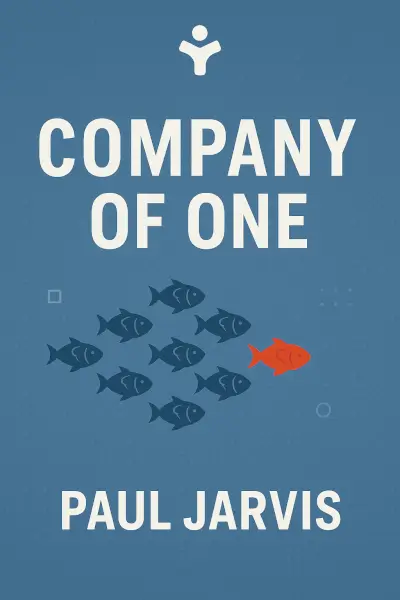
Company Of One: Why Staying Small Is the Next Big Thing for Business
Ready to Take Action?
Get the Mentorist app and turn insights like these into daily habits.