Failing Fast: The Counterintuitive Path to Uncovering What Works
The relentless pressure to get things right often holds people back, but the reality of innovation is that most first attempts will flop. At Netflix, countless prototypes—even entire business models—were tested and discarded at lightning speed. Rather than chasing certainty, the team ran quick, cheap experiments to learn exactly where the pitfalls were. This 'fail fast' mindset meant failure was not an endpoint, but an information-gathering process. Behavioral scientists call this 'iteration bias': the human tendency to prefer refining a working system rather than scrapping what doesn’t serve. When teams are free to experiment without fear, progress accelerates. The trick isn't to avoid being wrong, but to be wrong as quickly, cheaply, and informatively as possible.
Start each project by honestly noting what might fail and how even a flop will move you forward. Build tests that are small, fast, and simple to reverse so setbacks never become disasters. After each trial, make it a ritual to analyze what you learned before celebrating success. It’s not about winning or losing—it’s about evolving in public, and that’s how you gain real momentum.
What You'll Achieve
You’ll become more comfortable with risk, develop resilience through learning, and gain actionable insights at a faster pace. Over time, this leads to higher-quality solutions, less fear of judgment, and the ability to outlearn competitors.
Design Experiments That Embrace (and Learn From) Failure
Label Each Test as a Learning Opportunity.
When starting a project, reframe your main question from 'Will it succeed?' to 'What will we discover if it fails?' Write this at the top of your plan.
Create Low-Stakes, Reversible Trials.
Test risky ideas on a small or temporary basis so you can adjust quickly without major loss. Focus on minimizing permanent consequences for fast pivots.
Review Every Failure for Useful Data.
After a test, gather your team to extract 2–3 key lessons and hypotheses for next time. Publicly celebrate every insight that came from a failed approach.
Reflection Questions
- What keeps you from launching ideas before they're 'perfect'?
- How do you react emotionally to failures and what could shift your response?
- Where could small, reversible trials reveal new opportunities in your life?
- How do you capture and share lessons learned within your network?
Personalization Tips
- Trying a new club meeting format for a month to see which parts flop, then changing course based on member feedback.
- Cooking an unfamiliar recipe and openly discussing with family what worked and what was just 'interesting.'
- Testing a study habit for two weeks and reflecting with classmates on what actually improved recall or not.
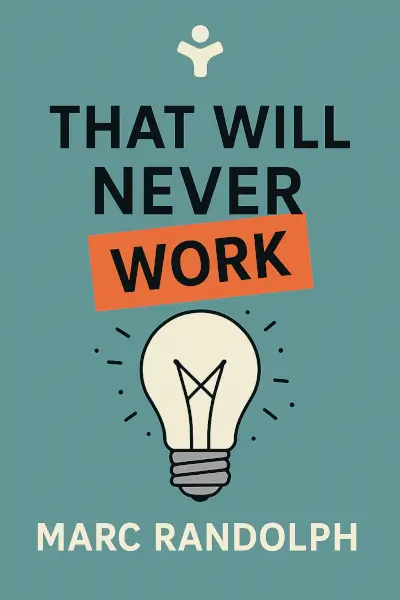
That Will Never Work: The Birth of Netflix and the Amazing Life of an Idea
Ready to Take Action?
Get the Mentorist app and turn insights like these into daily habits.