The vaccine one doctor said wasn't meant for people like her
When Eula Biss asked her son's pediatrician why newborns receive the hepatitis B vaccine, he answered warmly, 'That's a very good question,' in a tone that told her he enjoyed the answer he was about to give. Hep B, he explained, was really a vaccine for the inner city, designed to protect the babies of drug addicts and prostitutes. It wasn't something people like her needed to worry about.
Biss took this as reassurance at the time. She lived, after all, outside the inner city, technically. It took her longer than she'd like to admit to notice the racial coding underneath his comment, and longer still to realize what it implied: that this particular protection wasn't meant for her family, only for someone else's.
That framing turns out to have a real history behind it, and a real cost. When the hep B vaccine was introduced in 1981, it was recommended only for 'high risk' groups: prisoners, health care workers, gay men, IV drug users. Rates of infection didn't budge. It was only when the vaccine was recommended for every newborn a decade later, regardless of risk group, that infection rates actually fell, and the disease has now been nearly eliminated in children. Targeting the vaccine at people already labeled risky had missed most of the actual transmission, since the most common way an infant contracts hep B is from a mother who doesn't even know she's infected.
This pattern of who bears the risk of disease prevention runs much deeper. In the smallpox epidemics of the late 1800s, police in some American cities vaccinated immigrant families at gunpoint, and vaccination itself carried real dangers then, including infection with tetanus, dangers absorbed almost entirely by the poor for the benefit of everyone else. Today, that picture has partly reversed: research on unvaccinated children in the United States finds them more likely to be white, to have an older married mother with a college degree, and to live in higher-income households, while undervaccinated children are more likely to live in poverty. When wealthier families opt out, they are often relying, whether they realize it or not, on immunity carried by people with far less power to opt out themselves.
The next time you hear a public health measure described as being 'for' some other group of people, pause and ask who actually carries the disease, not just who gets blamed for it, since those are often different populations entirely. Look into the actual history of any vaccine you're deciding about, since 'high risk' targeting has repeatedly failed where universal protection succeeded. Notice if your own comfort or hesitation about a vaccine assumes someone else, somewhere else, will absorb the risk instead of you. And when you talk to your own doctor about a recommendation, ask directly whose interests it's protecting, rather than accepting a reassuring answer that quietly excludes you from the group that needs it.
What You'll Achieve
You learn to notice when a health recommendation is quietly coded as being for someone else, and you start checking the actual facts of transmission and history instead of accepting comforting assumptions about who bears the risk.
Ask who actually bears the risk
*Question who a health measure is 'for'*
When a public health measure is described as being for some other group, ask who actually contracts and spreads the disease, since that's often a different population than the one being blamed.
*Check the vaccine's actual history*
Look into whether a vaccine was ever targeted only at a 'high risk' group and what happened to infection rates before universal recommendation.
*Notice assumptions about who absorbs risk*
Ask whether your comfort with skipping a health measure quietly assumes someone else, somewhere else, will carry the consequence instead of you.
*Ask your doctor whose interests a recommendation protects*
Push past a reassuring answer that excludes your family from the group that needs protection, and ask directly who the recommendation is actually meant to protect.
Reflection Questions
- Have I ever assumed a health warning didn't apply to me because of how it was framed?
- Who has historically absorbed the risk of a disease prevention effort I benefit from?
- What would change in my own decision if I asked who actually gets sick, rather than who gets blamed?
Personalization Tips
- A parent researching a vaccine discovers it was originally targeted at a stigmatized group and realizes the actual transmission risk applies to everyone, including their own family.
- Someone assumes a public health campaign doesn't apply to their neighborhood until they check the local data and find otherwise.
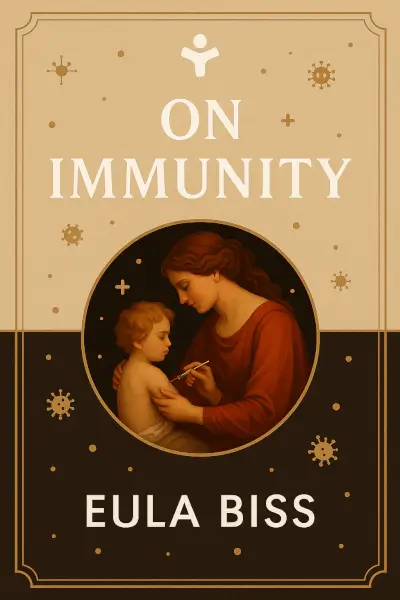
On Immunity: An Inoculation
Ready to Take Action?
Get the Mentorist app and turn insights like these into daily habits.