Environmentalists rarely learned to love nature by being taught to save it
Picture a strip of weeds at the edge of a parking lot, the kind of place most adults walk past without a second glance. To a child left alone there for twenty minutes, it can become a country of its own: an ant highway to follow, a hideout behind a shrub, a smell of hot asphalt and green growing things that never quite repeats anywhere else. Richard Louv argues that moments like this, small, unglamorous, and easy to miss, do something that a class trip to a rainforest exhibit rarely manages: they build attachment.
In 1978, environmental studies professor Thomas Tanner surveyed staff and chapter officers of major environmental organizations, asking what had actually pointed them toward a life of activism. The answer wasn't environmental education in the classroom sense. It was, overwhelmingly, childhood experience of natural, rural or otherwise wild habitats, places they could return to freely, almost every day, without an adult organizing the visit. Decades later, Cornell researchers Nancy Wells and Kristi Lekies confirmed the pattern in a broader sample of adults: environmental concern and behavior traced back most reliably to unstructured wild play before the age of eleven, not to mandatory, adult-run activities. Free play in nature, oddly enough, seems to matter more than programs designed specifically to teach children to care about it.
Environmental psychologist Louise Chawla, building on this, has studied what she calls ecstatic places, moments of intense delight or fear in nature during childhood that lodge in memory and keep emitting a kind of energy for the rest of a life. These moments don't require a mountain range. Chawla found they could be triggered by a clump of weeds outside a sleeping porch, or a single afternoon's escape into some scrubby corner during a school outing. What they require is freedom, time, and the chance to be surprised by something ordinary.
Louv connects this to attachment theory from child psychology, the idea that the quality of a child's early bond, to a parent or to a place, shapes how securely they move through the rest of their life. A child who never gets the chance to attach to any particular patch of ground, he suggests, may grow into an adult with no particular reason to defend one, which matters as the average age of environmental group members keeps climbing and their numbers thin. Passion for a place, it turns out, is rarely taught. It's caught, usually somewhere nobody thought to call a classroom.
Let your child return, again and again, to the same small wild-ish place near home, a creek edge, a weedy lot, a hedge at the back fence, with as much freedom as you can safely allow. When they stop to stare at something ordinary, an ant trail, a puddle, a beetle, stay there with them instead of moving things along. Hold off on lessons about saving the planet until the place has had a chance to mean something to them first. And if you can, put one attentive adult in their life who shows quiet appreciation for what's out there rather than fear of it.
What You'll Achieve
The listener understands that lasting environmental concern grows out of free, repeated, unsupervised attachment to a real place rather than out of lessons about endangered species, and starts protecting the conditions for that attachment in a child's life.
Let a place become theirs before you teach them to protect it
Let your child return to the same wild-ish spot repeatedly
A creek edge, a weedy lot, a hedge at the back fence counts as much as a park, with as much freedom as you can safely allow.
Follow their attention instead of directing it
When they stop to watch something ordinary, an ant trail, a puddle, stay with them rather than moving them along.
Hold off on the lecture about saving the planet
Let the delight or fear of the place come first, and let concern for it grow from that, not the other way around.
Find them one attentive adult mentor
Someone who shows quiet appreciation for what's there rather than fear of it or indifference to it.
Reflection Questions
- Is there a specific place, however small or unremarkable, that you were attached to as a child, and can you name what it gave you?
- Do the environmental lessons in your child's life come mostly from screens and units, or from actual return visits to a real place?
- Who was the adult, if any, who showed you attentiveness toward nature rather than fear or indifference, and could you be that person for a child now?
Personalization Tips
- A parent stops steering a walk toward the nice part of the park and lets their child linger at a muddy drainage ditch instead, because that's where the attention is.
- A summer camp counselor skips the scripted lecture on endangered species and instead gives kids unstructured time at the same pond every day for a week.
- An aunt who loves birds takes her niece along on ordinary errands near a wetland without turning every outing into a lesson, and lets curiosity build on its own.
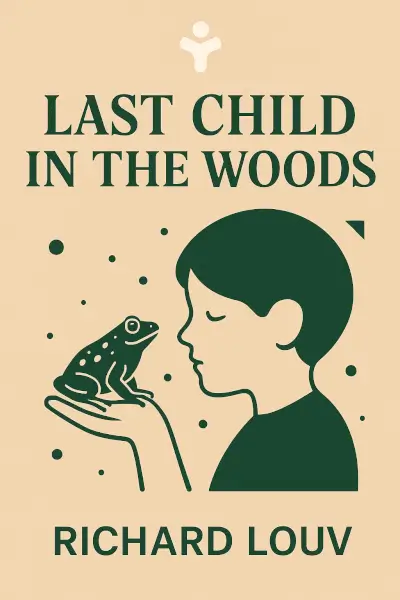
Last Child in the Woods: Saving Our Children From Nature-Deficit Disorder
Ready to Take Action?
Get the Mentorist app and turn insights like these into daily habits.