Why a fifth grader said cutting down her woods felt like losing herself
In a fourth-grade classroom in Raytown, Missouri, Richard Louv set up his tape recorder and asked a room full of children what nature meant to them. Most answers were the ones he'd heard everywhere: no time, too much homework, television. Then a serious girl in a plain print dress told him she wanted to grow up to be a poet. She had a place in the woods behind her house, a hole she'd dug near a waterfall and a creek, where she kept a tent and sometimes fell asleep looking up at the sky. "It's like you're free when you go out there," she said. "It's your own time." When she was angry, she went there, and came home calm, and her mother never knew why.
Then the woods were cut down.
"It was like they cut down part of me," she told him, her face flushing.
Louv had spent years hearing versions of this story, first while researching an earlier book, Childhood's Future, during which he interviewed nearly three thousand children and parents. A boy in San Diego told him he preferred playing indoors "'cause that's where all the electrical outlets are." Parents across the country, in Kansas and Pennsylvania alike, described the same shift: their own childhoods had been soaked in unsupervised outdoor time, and their children's were not.
Louv gave this shift a name: nature-deficit disorder. He is careful to say it is not a medical diagnosis, and no psychiatric manual lists it. It is a way of talking about what happens when the bond between children and the natural world breaks: diminished use of the senses, more attention difficulties, higher rates of physical and emotional trouble. The pattern shows up in individuals, but also in families and whole communities, in the design of neighborhoods, in crime rates linked to the absence of parks.
What makes the girl's story matter is not that she lost a nice place to play. It's that the woods were doing something for her that nothing else did, and she knew it precisely enough to describe it, and no one asked her before it disappeared. That absence of asking, multiplied across millions of children, is the disorder Louv is naming.
Start by simply listening: notice when a child mentions the outdoors only in passing, or explains a preference for staying inside in a way that reveals how little the outside means to them. Then look honestly at the last seven days and count how much of that time was truly unstructured and outside, apart from practice fields and organized games. If the number is thin, find one unclaimed strip of green nearby, a vacant lot, a ditch, the ragged edge of a canyon, and let your child return to it on their own terms. Ask what it means to them before anything happens to it, a move, a mower, a new development, because once it's gone, the chance to ask is gone with it.
What You'll Achieve
The listener starts noticing the specific, concrete ways nature has quietly disappeared from a child's ordinary week, rather than treating the problem as vague nostalgia, and begins protecting or restoring at least one real outdoor place before it is paved over or scheduled away.
Notice the disconnect before you can close it
Listen for the language of disconnection
Catch the throwaway lines, like a child preferring to stay inside because that's where the electrical outlets are, and treat them as data, not just a joke.
Audit a week of real outdoor time
Count only unstructured, unsupervised outdoor time, not practice fields or scheduled games, and see how thin the number actually is.
Find or protect one wild-ish patch nearby
A vacant lot, a ditch, a canyon edge, a hedge at the back fence all count; it doesn't need to be a park.
Ask before it's gone
Find out what a place means to your child before a move, a mower, or a development decision takes it away without warning.
Reflection Questions
- When you picture your own best childhood memory outdoors, what made it happen, and does your child have any equivalent opportunity right now?
- Is there a place near your home that your child has claimed as their own, and do you actually know where it is?
- What language do the children in your life use about the outdoors, and what does it reveal about how they experience it?
Personalization Tips
- A parent working from home notices their ten-year-old default to a tablet the moment school ends, and starts asking what he did outside that day, not just what happened in class.
- A teacher planning a field trip picks the overgrown lot behind the school instead of a distant nature center, so kids can return to it on their own.
- A grandparent visiting for the weekend takes a grandchild to the creek she played in as a girl, and asks what the grandchild's own hideouts feel like, before offering her own memories.
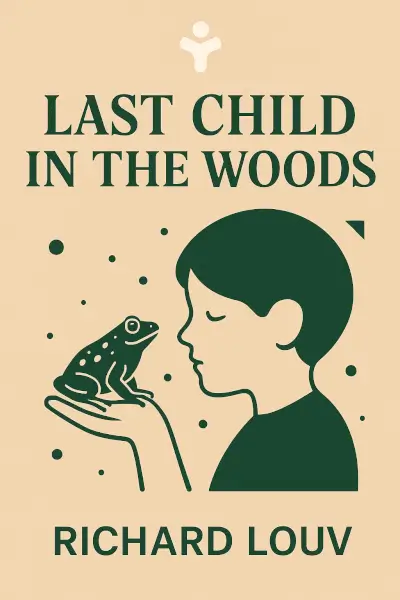
Last Child in the Woods: Saving Our Children From Nature-Deficit Disorder
Ready to Take Action?
Get the Mentorist app and turn insights like these into daily habits.