A grieving widower got no sympathy from his doctor, and it worked
An elderly general practitioner came to see Viktor Frankl in a state of severe depression. Two years earlier his wife had died, and he had loved her, in his own words, above everyone else. He could not get past it. Frankl says he chose not to offer sympathy or advice. Instead he asked the man a single question: what would have happened, doctor, if you had died first, and your wife had been the one left to survive you?
The old man answered without hesitation, it would have been terrible for her, she would have suffered so much. And there it was. Frankl pointed out that this suffering had been spared her, and that it was precisely the widower's own survival, his own grief, that had spared her from it. He had not lost meaning; he had, without realising it, made a kind of sacrifice, paying with his own pain to spare hers. The man said nothing, but shook Frankl's hand and left calmly.
Frankl is careful about what this story does and doesn't prove. It was not therapy in the strict sense, the man's despair was not a disease to cure, and nothing could bring his wife back. What changed was his attitude toward a fact that could not be altered. This is the third of the three routes to meaning that Frankl's logotherapy describes: not creating something, not encountering someone, but the stance you take toward suffering you cannot escape. Where an illness cannot be cured, where a loss cannot be undone, the challenge shifts from changing the situation to changing yourself in relation to it, turning a personal tragedy into something closer to an achievement.
He is equally clear about the limit of this idea, because it gets misused. Meaning is possible in spite of suffering, not because of it. If a source of suffering can be removed, a bad job, a treatable illness, an unjust situation, then the right response is to remove it, not to search nobly for meaning inside it. Frankl even says, bluntly, that suffering unnecessarily is closer to self-punishment than to heroism. The idea applies only where the door truly is locked: when nothing you do will change the outcome, and the only remaining question is what your bearing it will have been worth.
Start by being honest with yourself about which parts of your situation are genuinely fixed and which only feel that way. For whatever truly cannot be changed, ask a pointed question: what has your enduring this spared someone else, or made possible, even in a small way? Let that answer reframe the suffering as a task you are carrying out rather than a senseless waste landing on you. Watch for the trap of assuming any hardship must be borne nobly, if a cause can actually be removed, remove it, this only applies to what's genuinely unavoidable. Where it does apply, let yourself find a small, specific dignity in how you're bearing it, rather than searching for some grand justification for why it happened.
What You'll Achieve
You'll have a way to face suffering that genuinely cannot be undone without either denying it or being crushed by it, by finding what your bearing it has made possible for someone else. Visibly, you'll stop searching for someone to blame or something to fix when there is truly nothing left to fix, and start asking a different, more useful question.
How to find meaning in suffering you cannot undo
*Separate the changeable from the unchangeable*
Be honest about which parts of your situation are genuinely fixed and which only feel that way.
*Ask what your suffering has spared or accomplished*
For what truly cannot be changed, ask what your enduring it has spared someone else, or made possible, even in a small way.
*Reframe endurance as a task, not a waste*
Let the answer turn the suffering into something you are carrying out rather than something senselessly landing on you.
*Don't manufacture suffering that isn't unavoidable*
If a cause of suffering can actually be removed, remove it; this reframing only applies to what is genuinely unavoidable.
Reflection Questions
- What in your life right now is genuinely unchangeable, as opposed to just hard to change?
- What has your enduring a difficult situation spared someone else, even if they never say so?
- Are you carrying suffering that could actually be removed, rather than only endured, and are you mistaking endurance for virtue?
- What would it mean to call your suffering a sacrifice rather than a waste?
Personalization Tips
- Someone caring for a parent with an incurable illness can find meaning not in the disease itself but in what their steady presence spares the rest of the family.
- A person living with chronic pain that no treatment has fixed can still choose whether to meet each day with bitterness or with quiet resolve, even though the pain itself won't move.
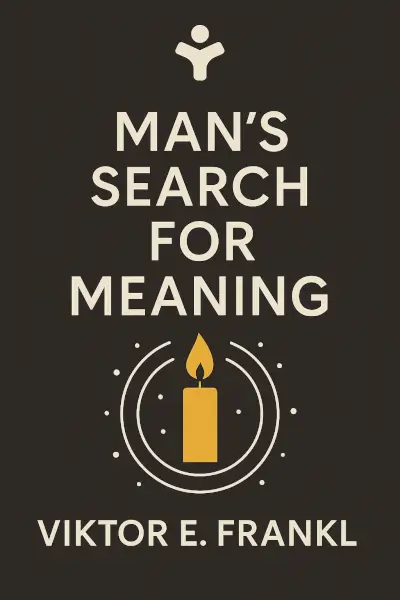
Man's Search for Meaning
Ready to Take Action?
Get the Mentorist app and turn insights like these into daily habits.